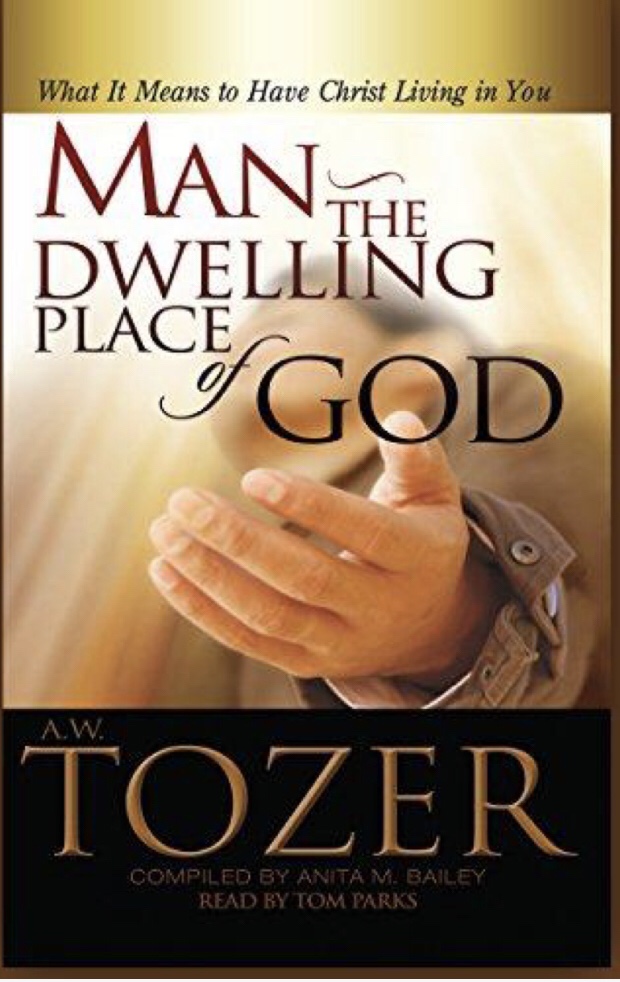
Man: The Dwelling Place of God
I’m just sharing some challenging quotes, for me, from this book thus far.
Chapter 29 How to Try the Spirits
⁃ “Tender-hearted Christians often become victims of strong psychological pressure applied intentionally or innocently by someone’s personal testimony, or by a colourful story told by a fervent preacher who may speak with prophetic finality but who has not checked his story with the facts nor tested the soundness of his conclusions by the Word of God. Whatever originates outside the Scriptures should for that very reason be suspect until it can be shown to be in accord with them. If it should be found to be contrary to the Word of revealed truth no true Christian will accept it as being from God. However high the emotional content, no experience can be proved to be genuine unless we can find chapter and verse authority for it in the Scriptures. “To the word and to the testimony” must always be the last and final proof.”
⁃ “While true power lies not in the letter of the text but in the Spirit that inspired it, we should never underestimate the value of the letter. The text of truth has the same relation to truth as the honeycomb has to honey. One serves as a receptacle for the other. But there the analogy ends. The honey can be removed from the comb, but the Spirit of truth can not and does not operate apart from the letter of the Holy Scriptures. “For this reason a growing acquaintance with the Holy Spirit will always mean an increasing love for the Bible. The Scriptures are in print what Christ is in person. The inspired Word is like a faithful portrait of Christ. But again the figure breaks down. Christ is in the Bible as no one can be in a mere portrait, for the Bible is a book of holy ideas and the eternal Word of the Father can and does dwell in the thought He has Himself inspired.”
⁃ “A good rule is this: If this experience has served to humble me and make me little and vile in my own eyes it is of God; but if it has given me a feeling of self-satisfaction it is false and should be dismissed as emanating from self or the devil. Nothing that comes from God will minister to my pride or self-congratulation. If I am tempted to be complacent and to feel superior because I have had a remarkable vision or an advanced spiritual experience, I should go at once to my knees and repent of the whole thing. I have fallen a victim to the enemy.”
⁃ “Sometimes an earnest Christian will, after some remarkable spiritual encounter, withdraw himself from his fellow believers and develop a spirit of fault-finding. He may be honestly convinced that his experience is superior, that he is now in an advanced state of grace, and that the hoi polloi in the church where he attends are but a mixed multitude and he alone a true son of Israel. He may struggle to be patient with these religious worldlings, but his soft language and condescending smile reveal his true opinion of them – and of himself. This is a dangerous state of mind, and the more dangerous because it can justify itself by the facts. The brother has had a remarkable experience; he has received some wonderful light on the Scriptures; he has entered into a joyous land unknown to him before. And it may easily be true that the professed Christians with whom he is acquainted are worldly and dull and without spiritual enthusiasm. It is not that he is mistaken in his facts that proves him to be in error, but that his reaction to the facts is of the flesh. His new spirituality has made him less charitable.”
CHAPTER 30: RELIGIOUS BOREDOM
That there is something gravely wrong with evangelical Christianity today is not likely to be denied by any serious minded person acquainted with the facts. Just what is wrong is not so easy to determine. In examining the situation myself I find nature and reason in conflict within me, for I tend by temperament to want to settle everything with a sweep of the pen. But reason advises caution; nothing is that simple, and we must be careful to distinguish cause from effect. As every doctor knows there is a wide difference between the disease and the symptoms; and every Christian knows that there is a big difference between cause and effect in the sphere of religion.”
 Running Down Vimy