
At the centre — Ephesians 2:22
“In him you also are being built together into a dwelling place for God by the Spirit.”
The centre isn’t a program, a care structure, or even a particular calling.
It is a people being built together.
The question underneath the whole exploration might remain:
What changes if we don’t think of ourselves as people assigned to care for others, but as people learning to belong to one another?
Romans 12:5 — “members one of another.”
⸻
1. Mutuality — Romans 1:11–12
Paul begins:
I long to impart something to you…
and then almost corrects the direction of travel:
“…that we may be mutually encouraged by each other’s faith, both yours and mine.”
Not:
giver → receiver
strong → weak
leader → cared-for person
But:
one another.
I may strengthen you today. Tomorrow I may desperately need what God has put in you.
Question: What would church look like if care were fundamentally mutual rather than something one class of people provides for another?
⸻
2. Noticing — Who is in front of me?
This is woven through the stories in my backpack.
I notice:
- someone new;
- someone missing;
- someone sitting alone;
- someone who normally stays but leaves quickly;
- someone unusually quiet;
- someone whose normal vibrancy has disappeared.
Gavin wasn’t a “care need.” He was Gavin—and something had changed.
Gerard wasn’t an assignment. I knew him well enough to notice that he wasn’t himself.
Before intervention comes attention.
Question: Who do I notice—and who have I learned not to see?
⸻
3. Sit and listen — John 4
Jesus is genuinely tired, hungry and thirsty.
He sits beside a well.
And his opening words aren’t an announcement of what she needs from him:
“Give me a drink.”
She has the bucket.
Jesus doesn’t.
There is no spiritual performance required before an actual human encounter can occur.
Listen before explaining.
Encounter before diagnosis.
Relationship before fixing.
Question: Can I encounter someone without immediately needing to do something to them or for them?
⸻
4. THE INTERRUPTION — Perhaps they have the bucket
This changes something.
We’ve been imagining the person who notices and the person who is noticed.
But John 4 disrupts that distinction.
The supposedly needy person has something Jesus needs.
And then Luke 24 does it again.
Two confused, grieving disciples are walking toward Emmaus. Jesus knows what they don’t know. Yet he approaches them without announcing himself:
“Jesus himself drew near and went with them.”
He asks what they’re discussing.
They explain Jesus to Jesus.
And he listens.
But then something even stranger happens.
They arrive at Emmaus near nightfall:
“He acted as if he were going farther.”
They respond:
“Stay with us, for it is toward evening and the day is now far spent.”
They don’t know that they’re caring for the risen Christ.
They simply see a stranger who shouldn’t continue travelling alone into the night.
So they offer what they have.
Shelter.
Food.
A table.
Hospitality.
Only afterward do their eyes open.
This runs all the way back through Israel’s story.
Abraham welcomes strangers.
Lot insists that strangers not remain overnight in the square.
Israel is repeatedly commanded to remember:
You were strangers yourselves.
And Judges 19 gives us the horrifying opposite picture—Gibeah, where:
“no one took them into his house to spend the night.”
Then Jesus places himself in precisely that vulnerable position.
Will you welcome the stranger?
Not because you recognize Christ.
But because you recognize the stranger.
And Matthew 25 suddenly stands nearby:
“I was a stranger and you welcomed me.”
When did we see you?
Exactly.
They didn’t.
So perhaps the disruptive question is:
What does this person have that I need?
That keeps the “care leader” from unconsciously approaching another person as:
I have something. You lack something.
Perhaps I do have something to offer.
But perhaps they have the bucket.
⸻
5. Walk and listen — Luke 24
John 4 gives us:
Sit and listen.
Emmaus gives us:
Walk and listen.
Jesus accompanies before explaining.
He asks questions whose answers he already knows.
He permits people to tell their own story—even when their interpretation of the story is incomplete.
Only then does he begin opening Scripture.
So perhaps:
Presence → curiosity → listening → discernment → response.
Not every conversation needs to reach the final step.
Question: Can I walk beside somebody long enough to discover where they actually are rather than beginning with where I think they should be?
⸻
6. Don’t announce the inner machinery
This is connected to John 4 and Emmaus.
Suppose something inside me says:
Go talk to Gerard.
I could approach him with:
“God told me that something is wrong with you.”
Now Gerard has to deal not only with whatever he’s carrying but my claim about God.
Or I can simply say:
“Gerard, you seem quieter today. How are you?”
Perhaps the prompting was God.
Perhaps it was intuition.
Perhaps I’ve unconsciously noticed ten tiny changes in Gerard’s behaviour.
Perhaps all three.
I don’t necessarily need to know.
And Gerard certainly doesn’t need my explanation before I love him.
1 Thessalonians 5 gives us both:
Don’t quench the Spirit.
Test everything.
Question: Does this person need to know what’s happening inside me—or do I need them to know?
⸻
7. “Come and see” — John 1:39
John 1:12:
“…he gave the right to become children of God.”
See below under the heading of Soteriology *
There is that beautiful word:
become.
And when people begin seeking Jesus:
“Come and you will see.” — John 1:39
Later Philip says the same thing to Nathanael:
“Come and see.”
Receiving Christ doesn’t mean we stop seeking him.
We’ve found the One we now follow.
So none of us gets to say:
I’ve arrived. Come up here and I’ll explain reality to you.
Romans 12:1–2 keeps even the mature Christian in continuing transformation:
“be transformed by the renewal of your mind.”
Question: Can we create a community in which it remains safe to be becoming?
⸻
8. Presence before fixing
This is where your Mad World association belongs.
Click Here – for this song…
People can move through an entire Sunday surrounded by hundreds of human beings—
sing together,
listen together,
drink coffee together—
and remain profoundly unknown.
The answer isn’t necessarily more advice.
Sometimes it’s someone who sees.
Someone who asks.
Someone who stays.
Someone willing to hear something unresolved without rushing to make the uncomfortable tension disappear.
Question: Can I remain present with another person’s pain without needing to resolve it?
⸻
9. Listening-obedience
But listening isn’t passivity.
Sometimes the quiet internal prompting is:
Walk across the room.
Ananias is useful here.
He has perfectly reasonable objections concerning Saul.
Nevertheless:
“Go.”
There are moments when love becomes embodied simply because someone acts upon what they’ve heard.
Question: What happens between noticing and walking across the room?
⸻
10. Limits — “NOT ME”
One of the most important things in your handwritten backpack is:
“NOT ME.”
Seeing a need doesn’t automatically constitute a calling to meet it.
Paul plants.
Apollos waters.
God gives the growth.
Sometimes obedience means going.
Sometimes introducing.
Sometimes referring.
Sometimes praying.
Sometimes leaving someone alone.
Sometimes recognizing:
Someone else in the body has what this person needs.
Question: How do we distinguish noticing a need from being responsible for meeting it?
⸻
11. God gives the growth
Your note concerning Cheryl:
Plant a seed. Water. Let God grow it.
And alongside Ashton:
Don’t micromanage.
Those belong together.
Care becomes control when I assume responsibility for another person’s outcome.
I can plant.
I can water.
But if God gives the growth, there comes a moment when obedience means releasing another person back into God’s hands.
Question: Can I care deeply without taking possession of another person’s journey?
⸻
12. Heart before ministry
Joel 2: Rend your hearts, not merely your garments.
Matthew 5: Leave the offering and pursue reconciliation.
1 Samuel 15: Obedience is better than sacrifice.
These protect the whole thing from becoming religious activity.
I can become very busy “caring for people” while avoiding what God is asking to transform in me.
The caregiver remains someone being cared for.
The disciple-maker remains a disciple.
The person listening for God remains someone whose mind needs renewing.
Question: What kind of heart must I be becoming if another person’s heart is going to be safe with me?
⸻
13. Culture is caught — Carlos and Jasmin
Carlos and Jasmin imitate things they’ve seen in you and Cheryl.
But you’ve noticed that it’s easier because they’re entering a congregation where other people are already looking outward.
That’s important.
Perhaps Mark doesn’t ultimately need 50 people who permanently care for 250 others.
Perhaps he needs some people who carry and model a culture until it becomes contagious.
Someone notices because they’ve watched somebody notice.
Someone welcomes because they were welcomed.
Someone learns to listen because somebody once listened to them.
Eventually the person who was once “cared for” notices somebody else.
They have become part of the net.
⸻
14. A young church — an unusual opportunity
Your church’s relative newness matters.
There isn’t enormous institutional seniority yet.
That means the culture is still being formed.
Two or three hundred people is already large enough for somebody to become invisible.
But perhaps still small enough to establish something different before anonymity becomes normal:
“members one of another.”
Not fifty deputy pastors.
Perhaps fifty culture carriers among a congregation increasingly learning to notice one another.
⸻
15. And finally: Don’t codify the living thing
This is where Brennan Manning’s warning belongs.
And Parker Palmer’s willingness to remain in unresolved tension.
There will be pressure eventually to name this:
Care Ministry.
Discipleship Team.
Pastoral Care Leaders.
Congregational Care Network.
Maybe one of those eventually becomes useful.
But naming something too early can cause us to stop looking at it.
That’s why your backpack of names matters.
Anthony.
Gavin.
Gerard.
Vahid and Behnaz.
Carlos and Jasmin.
Ashton.
Cheryl.
And all the others.
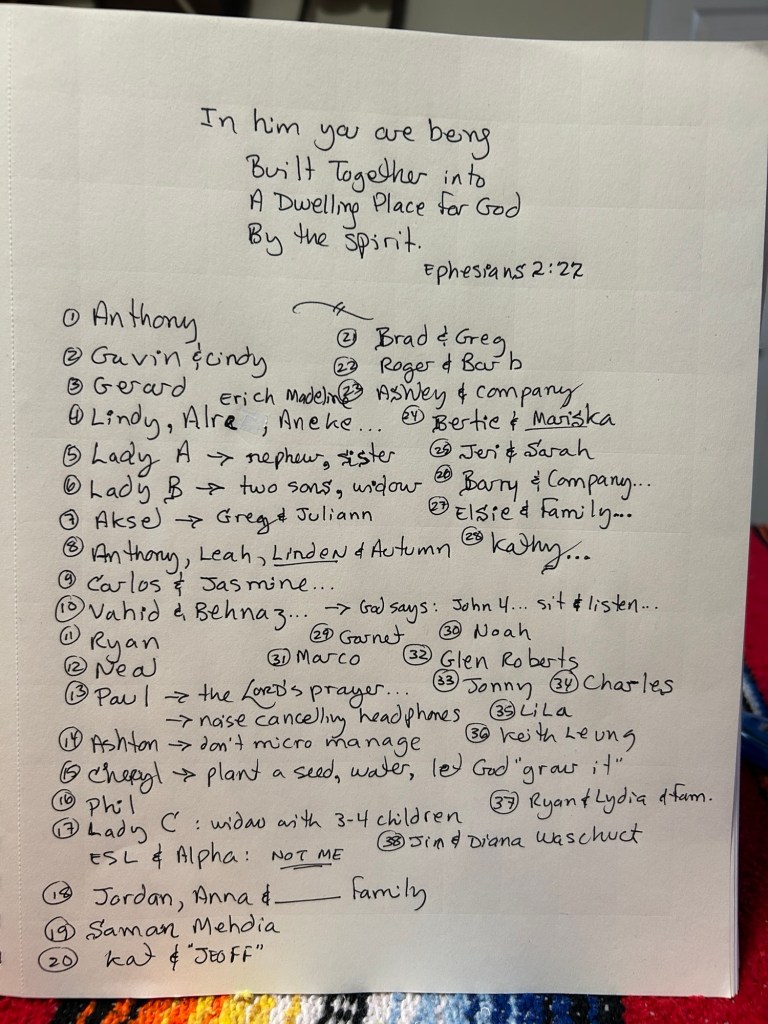
They’re not evidence supporting your model.
They’re stories from which you’re still learning.
And everyone else who comes into this conversation will arrive carrying a backpack too.
So perhaps Mark’s first gathering doesn’t need to begin with:
“Here’s what we’re going to build.”
It could begin with Romans 1:11–12 and one question:
Tell me about a time when you noticed someone—and what happened next.
Then listen.
Because if Ephesians 2:22 is true—if we are being built together into a dwelling place for God by the Spirit—then neither Mark nor Laurence should expect to walk into that room possessing the complete picture.
Somebody else may have the bucket. 😃
All of the above is the unpacking of my heart… bringing things out into the open air… into the light…
1 Thessalonians 5:____ test everything
These are not conclusions…
These are not teachings I intend to foist on the church…
These are the thoughts of my heart…
Romans 1:11-12 is about mutually encouraging… but if I might amend that… to mutually edify which is to build one another up… whether through engagement or exhortation.
ChatGPT >
Certainly grace isn’t something we earn. But that’s different from saying creation contributes nothing to vocation.
Psalm 139 lets you say: God made this particular creature.
Ephesians lets you say: there are works prepared for this particular life.
And Philippians 3—not 2:12, I think that’s the passage you’re reaching for—lets Paul say something astonishing after decades of discipleship: “Not that I have already obtained this or am already perfect…” Then comes pressing on toward that for which Christ took hold of him.
That is almost exactly your no-arrived-status thought.
Paul isn’t nineteen and inexperienced when he says I haven’t arrived.
He’s Paul.
Which gives another meaning to your bucket. Maybe discipleship isn’t God eventually replacing Laurence with a sufficiently sanctified generic Christian. Some things you’ve carried—your intuition, storytelling, noticing connections, curiosity about people, willingness to listen, even that mind that immediately starts constructing possible explanations—may be part of the created equipment.
The formation is partly learning how to hold the bucket.
Intuition can become intrusion.
Curiosity can become scrutiny.
Discernment can become codification.
Story-making can become certainty.
Or those same capacities can become wondering, listening, intercession, testimony and safe presence.
Soteriology
- I have been saved — an accomplished reality. Ephesians 2:8: “by grace you have been saved.” Often associated particularly with justification.
- I am being saved — an ongoing reality. Paul uses that language in 1 Corinthians 1:18: “to us who are being saved.” This connects naturally, though not exclusively, with sanctification.
- I will be saved — salvation also has a future consummation. Romans 5:9–10 speaks of “shall we be saved”; Romans 13:11 says salvation is “nearer to us now than when we first believed.” Ultimately, glorification.
So Christianity contains a wonderful tension:
Already — and not yet.
Word Study
That little code is grammatical shorthand describing γενέσθαι (genesthai):
vn 2Aor midD
- vn = verb, infinitive — there is no grammatical person (“I/you/he”) attached to it.
- 2Aor = second aorist — the aorist normally views the action as a whole rather than emphasizing an ongoing process. “Become” is being viewed as an event/change of state.
- midD = middle deponent — γίνομαι has middle-form morphology but is normally translated with an active English meaning: “become / come to be.” It does not mean “make yourself become.”
So I would be cautious with the interlinear’s “TO-BE-BECOMING.” That English wording can make genesthai sound like an ongoing, gradual process. The aorist infinitive doesn’t particularly suggest that.
In John 1:12, a much more natural sense is:
“He gave them the right/authority to become children of God.”
In other words, γενέσθαι isn’t telling us, “God gave them permission to begin a lifelong process of slowly becoming his children.” The grammar readily supports an actual transition: to come to be God’s children.
Formation and growing as God’s children certainly follow—but that’s a different question from what γενέσθαι itself is saying here.
And that distinction may be quite important for the thing you’re studying: becoming a child of God versus becoming mature as a child of God

