The two movements
Hebrews 11:1 — a way of seeing
“Faith is being sure of what we hope for and certain of what we do not see.”
This isn’t blind belief.
It’s a kind of orientation.
Living toward something unseen but trusted A quiet confidence that shapes how you walk today Openness… receptivity… a kind of leaning forward
Faith here is not forceful. It’s responsive.
Like someone who senses there is meaning, even if they can’t fully explain it.
Romans 1:21 — a way of closing
“For although they knew God, they neither glorified Him as God nor gave thanks to Him… their thinking became futile and their foolish hearts were darkened.”
Notice the shift:
They knew, but didn’t respond They withheld gratitude Their inner world closed in on itself
This isn’t about ignorance.
It’s about a kind of turning away.
And then something happens:
Thinking becomes futile (loops, dead ends) The heart becomes darkened (less able to perceive)
Put side by side
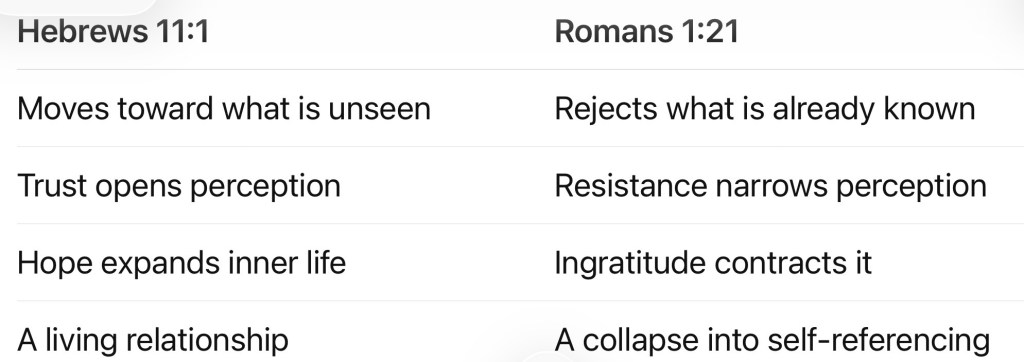
A deeper layer (this is where it gets real) These aren’t just theological categories. They’re patterns you can feel inside yourself.
You can almost ask:
When I’m open, trusting, quietly receptive… what happens to my awareness? When I’m closed off, withholding, or subtly resistant… what happens instead?
One leads to:
“There is more here than I can see yet.”
The other drifts toward:
“This is all there is… and it’s not enough.”
From an inner-life perspective
Here’s something worth noticing carefully:
Faith (Hebrews 11:1) doesn’t eliminate uncertainty → it makes room for it, while still moving forward Futility (Romans 1:21) tries to control or dismiss → and ends up shrinking what can be seen
So paradoxically:
The person who accepts not seeing… begins to see more
The person who insists on certainty… ends up seeing less
A gentle question for you
Not to answer quickly—just to sit with:
Where in your life right now do you sense that quiet pull of trust, even if you can’t explain it?
And alongside it:
Where do you notice a kind of tightening… a resistance… maybe even a loss of gratitude?
One small step (if you were to take one)
Not a big spiritual move. Just something grounded:
Notice one ordinary moment today (coffee, a conversation, a walk) Instead of analyzing it… receive it Let yourself say, even quietly: “There’s more here than I can see.”
That’s actually very close to Hebrews 11:1 in lived form.
If you want, we can bring this into your writing—this contrast fits perfectly with your “doorways” idea. It’s almost like two doors in the Great Hall:
One opens into widening light The other into narrowing corridors
But both start from very small inner movements.
Where does this land for you?
Because as you describe that image—“wear your helmet”—there’s something in it that feels… almost relieving. Like the fog clears a bit.
Let’s stay with that picture for a moment
Simple. Concrete. Actionable.
Not:
analyzing every accident debating causes endlessly fearing every ride
Just:
Put the helmet on. Ride.
There’s a kind of grounded clarity in that.
Now connect it to what you just read
A lot of talk about “spiritual warfare” can drift into:
- complexity
- speculation
- even a bit of fear
- or intensity
But what you’re drawn to in Chip Ingram is almost the opposite:
The battle is real… but the response is simple and lived
That matters.
Because if something is true but not livable, people either:
avoid it or get tangled in it
Let’s gently tie this back to those verses
Think about it this way:
Hebrews 11:1 — “wear your helmet”
You don’t see everything You don’t control everything But you live in trust anyway.
It’s not dramatic.
It’s steady.
Romans 1:21 — “ride without it, while arguing about helmets”
Knowing… but not responding Drifting into abstraction Losing something simple that was right in front of you
Not rebellion in a loud sense—
more like a quiet refusal to engage what you already know matters
Here’s the part I want to nudge you on (gently, but honestly)
It’s easy—even for thoughtful people like you—to move toward:
rich ideas layered metaphors deep reflection
You’re very good at that.
But there’s a risk:
You can stand beside the table… admiring the helmet… instead of just putting it on.
So let me ask you something direct
What is the “helmet” for you right now?
Not in theory. Not in a piece of writing.
In your actual, lived day:
a way of speaking? a posture with someone? a small act of trust? a refusal to spiral into certain thoughts?
A small experiment (very ACT-like, but lived)
Today, instead of trying to resolve everything:
Notice a moment where your mind wants to go abstract or heavy Pause Ask: “What would wearing the helmet look like right here?” Do just that one thing
No drama. No explanation.
One last reflection
The power of that image isn’t that it solves everything.
It’s that it keeps you moving in the right direction without getting lost in the fog.
And that’s actually very close to faith as Hebrews describes it.
If you sit with it for a minute—
Where do you already know what the “helmet” is… but maybe haven’t quite put it on yet?
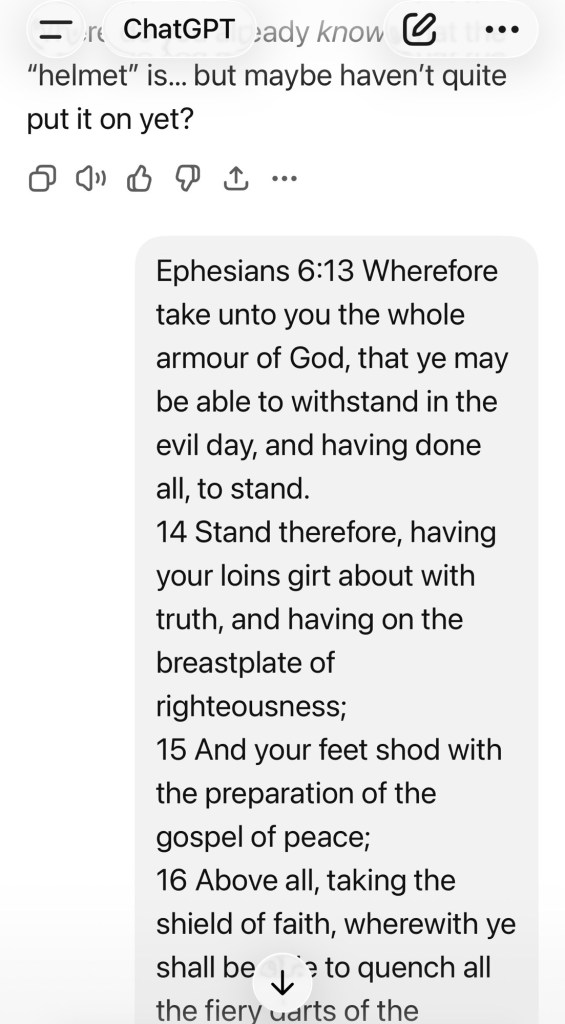
Because when you lay this passage out like that, it doesn’t read like theory at all. It reads like equipment laid out on a bench… ready to be picked up.
Let’s slow it right down
Notice the rhythm:
- Take
- Stand
- Wear
- Pray
Nothing flashy.
No chasing.
No attacking first.
Just:
Be prepared… and remain standing
That’s already different from how people often imagine “warfare.”
The tone of the passage
There’s something almost quiet about it.
Not:
panic intensity frantic movement
But a kind of grounded steadiness:
“having done all… to stand”
That line matters.
It suggests:
there is an “evil day” there are pressures, thoughts, accusations, fears
But the aim isn’t to control everything.
It’s:
to not be knocked off your footing
Let’s walk through the “armor” as lived experience
Not as doctrine. As something you can feel in yourself.
Truth (belt)
Not abstract truth.
More like:
“What is actually real right now?”
When your mind starts spinning, truth gently brings you back:
This is what’s happening This is what I know
Righteousness (breastplate)
Not perfection.
More like:
“I am not defined by every accusation that shows up in my mind”
It protects your core from:
shame spirals self-condemnation
Gospel of peace (shoes)
This one is easy to miss.
It’s not just having peace.
It’s being ready to walk in it.
Even when things feel tense.
Faith (shield)
This connects directly to Hebrews 11:1.
Faith here isn’t a feeling.
It’s:
“I’m going to trust what is unseen… even while this is hitting me”
And notice:
the darts are still flying faith doesn’t stop them from existing
It extinguishes their effect
Salvation (helmet)
Here’s your image again.
The helmet protects your mind.
Think of it as:
“I am held. I am not lost. This story is not ending here.”
It keeps your thinking from collapsing.
Word of God (sword)
Not for winning arguments.
More like:
cutting through distortion
A clear word that says:
this thought isn’t true this fear isn’t the whole story
Prayer (the atmosphere of it all)
Not a final add-on.
It’s like:
staying connected… staying awake… staying present
Now… let’s bring this into your earlier insight
Your “helmet sign” idea is actually very close to what Paul is doing here.
He’s not saying:
analyze every scheme map out every enemy
He’s saying:
Put this on. Stand. Stay awake.
A gentle challenge (because this is where it can slip)
It’s possible to:
admire the armor understand each piece even teach it
…and still stand there unarmored
So let me ask you something experiential:
Right now, in your actual life
Where do you feel “pressure” or “darts” lately?
Not abstractly—just honestly:
a relationship? a discouraging thought pattern? a quiet heaviness?
Now instead of solving it, try this:
Which one piece of the armor fits that moment?
Not all of it. Just one.
Truth? Faith? Peace? The helmet?
One small, grounded step
Pick one situation today.
And instead of thinking your way out of it, just:
“Put on” one piece
For example:
“Right now, I choose to stand in truth: this thought is not the whole story” or “Right now, I lift the shield: I will trust even though I don’t see”
No drama. Just practice.
One last thing to notice
This whole passage assumes something very important:
You are already in the field
Not preparing for someday.
Not waiting until you feel ready.
You’re already there.
So maybe the real question isn’t:
“Do I understand the armor?”
But:
“Am I standing… or slowly stepping back?”
Where do you sense yourself in that right now?
 Running Down Vimy