Learning to Listen Together: What the Quakers Have to Teach Us
no fixing, no advising, setting each other straight
Parker Palmer
In A Hidden Wholeness, Parker Palmer frequently draws from his experience among the Quakers (also known as the Religious Society of Friends). He is not writing primarily about Quaker theology, but about a way of gathering that has profoundly shaped his understanding of community, discernment, and the presence of God.
Many Christians may find some of these practices unfamiliar. Yet beneath them lie deeply biblical convictions: that Christ is present among His people, that the Holy Spirit speaks, and that believers can help one another hear God’s voice without controlling one another’s lives.
A People Who Expect God to Speak
The early Quakers emerged in seventeenth-century England through the ministry of George Fox. They became convinced that Christianity had become overly dependent on institutions, clergy, and religious forms while neglecting the direct leadership of Christ through the Holy Spirit.
Their central conviction was simple:
Christ is alive and present among His people.
Because of this, they believed every believer could learn to recognize and respond to the inward work of the Holy Spirit.
This conviction echoes many biblical passages:
- “My sheep hear my voice.” (John 10:27)
- “You may all prophesy one by one.” (1 Corinthians 14:31)
- “The anointing you received from Him remains in you.” (1 John 2:27)
- “Where two or three gather in my name, there am I among them.” (Matthew 18:20)
The Quaker Meeting for Worship
Perhaps the most distinctive Quaker practice is their gathering for worship.
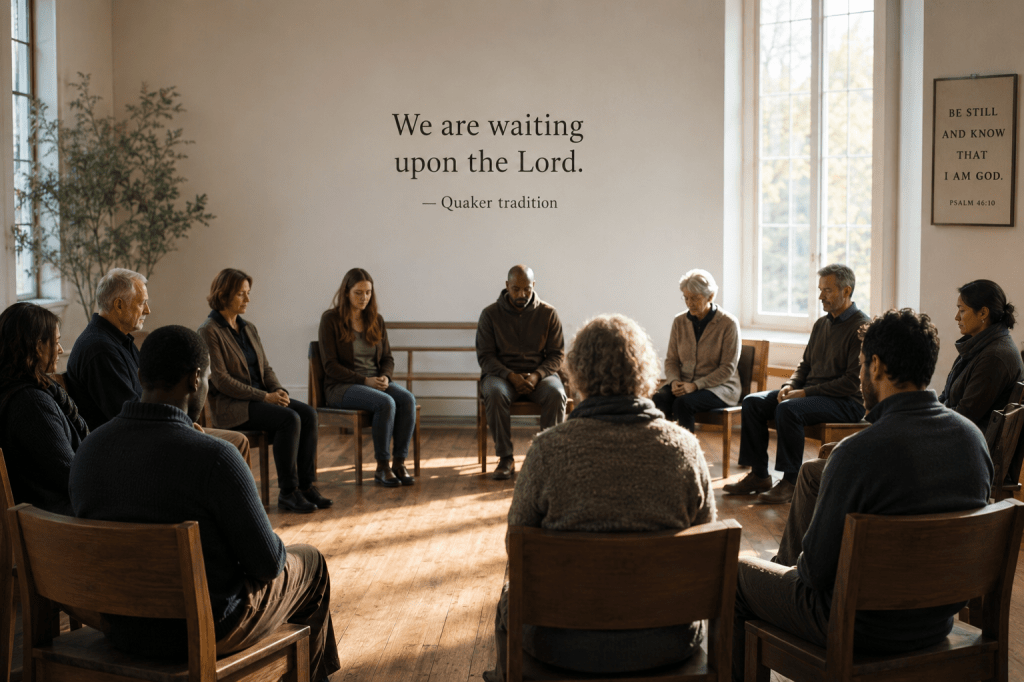
Participants enter quietly and sit together in silence. There is no prepared sermon, worship team, or order of service.
The silence is not empty.
Rather, it is an act of waiting.
Each person seeks to become attentive to God’s presence and leadership. If someone senses they have been given a message for the group, they may stand and speak briefly. Otherwise, the silence continues.
A visitor might wonder:
“What are they doing?”
The Quaker answer would be:
“We are waiting upon the Lord.”
This practice has deep biblical roots.
Throughout Scripture we find God’s people learning to wait, listen, and discern:
- “Be still, and know that I am God.” (Psalm 46:10)
- “Speak, Lord, for your servant is listening.” (1 Samuel 3:9)
- “Wait for the Lord.” (Psalm 27:14)
- The disciples gathered in prayer awaiting the Spirit. (Acts 1:14)
While most churches express worship through singing, preaching, and prayer, Quakers intentionally create space for listening.
Discernment Without Advice
One of Parker Palmer’s most influential descriptions concerns what Quakers call a clearness committee.
When someone faces a major life decision, a small group gathers around them.
The purpose is not to give advice.
The purpose is not to solve their problem.
The purpose is not to persuade them toward a particular outcome.
Instead, participants ask honest and open questions.
Questions such as:
- What seems most alive in you when you speak about this?
- What fear accompanies this decision?
- What would faithfulness look like?
- What are you reluctant to admit?
The assumption is that the individual stands before God and that God is already at work within them.
The community’s role is not to take the reins.
Their role is to help the person hear more clearly.
This reflects several biblical principles:
- “Each of us will give an account of ourselves to God.” (Romans 14:12)
- “Test everything; hold fast to what is good.” (1 Thessalonians 5:21)
- “The purposes of a person’s heart are deep waters, but one who has insight draws them out.” (Proverbs 20:5)
Rather than becoming someone’s director, the group becomes a listening companion.
The Gift of Silence
Modern life trains us to fill every space.
The Quakers remind us that silence can be more than the absence of noise.
It can become a place of encounter.
In silence we become aware of:
- our fears,
- our ambitions,
- our distractions,
- and sometimes the quiet prompting of God’s Spirit.
The goal is not silence for its own sake.
The goal is attentiveness.
Jesus Himself regularly withdrew to lonely places to pray (Luke 5:16), and many Christian traditions throughout history have practiced silence as a means of drawing near to God.
A Community That Refuses to Control
One of the most striking features of Quaker practice is their resistance to controlling other people.
Rather than telling someone what they should do, they seek to create a space where truth can emerge.
Parker Palmer often contrasts this with the tendency to “fix” people.
Most of us are quick to offer solutions.
We rush in with answers.
Yet Job’s friends remind us that not every suffering person needs advice.
Sometimes they need companions.
Sometimes they need listeners.
Sometimes they need people willing to sit quietly beside them.
The Quaker tradition has developed practices that encourage this kind of presence.
What Christians Can Learn
One need not become a Quaker to appreciate these insights.
Many believers from different traditions have found value in:
- waiting prayer,
- listening together,
- asking honest questions,
- resisting the urge to fix people,
- creating space for discernment,
- trusting the Holy Spirit’s work in others.
These practices remind us that Christian community is not merely about exchanging information.
It is about helping one another hear and respond to the living Christ.
Perhaps the greatest lesson is this:
God is already present and at work among His people.
Our task is not always to speak first.
Sometimes our task is simply to become quiet enough to listen.
Third Things
(Parker Palmer)
In Western culture, we often seek truth through confrontation. But our headstrong ways of charging at truth scare the shy soul away. If soul truth is to be spoken and heard, it must be approached “on the slant.” I do not mean we should be coy, speaking evasively about subjects that make us uncomfortable, which weakens us and our relationships. But soul truth is so powerful that we must allow ourselves to approach it, and it to approach us, indirectly. We must invite, not command, the soul to speak. We must allow, not force, ourselves to listen. We achieve intentionality in a circle of trust by focusing on an important topic. We achieve indirection by exploring that topic metaphorically, via a poem, a story, a piece of music, or a work of art that embodies it. I call these embodiments “third things” because they represent neither the voice of the facilitator nor the voice of a participant. They have voices of their own, voices that tell the truth about a topic but, in the manner of metaphors, tell it on the slant. Mediated by a third thing, truth can emerge from, and return to, our awareness at whatever pace and depth we are able to handle-sometimes inwardly in silence, sometimes aloud in community-giving the shy soul the protective cover it needs.
What this could look like:
The idea is something I’m calling “The Koinonia Walk.”
It’s a simple, low‑pressure social group where we meet for coffee or tea and take a walk together. Nothing formal — just a space for anyone or people who carry emotional or spiritual burdens.
Why “Koinonia”?
In Scripture, koinonia means more than casual fellowship. It’s “shared life” — sharing joys, faith, and especially burdens. It’s the kind of community described in Galatians 6:2, where we “carry each other’s burdens” as part of fulfilling the law of Christ.The heart behind it
A lot of people struggle quietly with guilt, shame, or unspoken worries. The goal isn’t therapy — it’s simply creating a safe place where confession and honesty are welcomed. When people can name their struggles out loud in a supportive environment, shame loses its power.How it would work
- Meet for a coffee or tea
- Walk together (which makes conversation feel more natural)
- Anyone can share a struggle or a sin if they want to
- We listen, offer grace, and keep things confidential — no fixing, no judgment
It’s really just a gentle way to help people feel less alone and more connected to the body of Christ.

