I’m hardly, hardly the one…

This guy is reading a book, mounted backwards on a horse going somewhere randomly forward, or maybe the horse knows the way? You can see it if you look west when driving south on Howe Street off ramp onto the Granville Street bridge in Vancouver, BC.
In Brief — Where I’m Going With This
What does it mean to handle God’s word rightly? I’m wrestling with the difference between knowing Scripture and living it, with the dangers of certainty, the damage done by prosperity teaching, and the temptation to become the very expert I’m questioning. Along the way there’s a horse facing the wrong way, a computer programmer, and a reminder that I am not the Light.
- Disputable Matters and Judging One Another — When theological disagreement becomes separation.
- The Cost of Prosperity Teaching — The people behind the arguments.
- Debt, Giving, and the Dream of Wealth — Money, vulnerability, and what churches owe one another.
- My Brother, the Computers, and the Teachers — Why expertise alone doesn’t make a good teacher.
- Experts in the Law, and the Light — Knowing the words without recognizing Christ.
- What Am I Really After? — The danger of wanting significance.
- Impeccability, Mystery, and Revelation — What can be debated, and what must be held humbly.
- Not Hearers Only — The purpose of studying Scripture.
- Discernment, Mental Health, and Spiritual Claims — Testing without presuming to know everything.
- The Work Given to Me: Be Ready — Following Jesus without demanding tomorrow’s itinerary.
1. Disputable Matters and Judging One Another
Carl’s (his name’s not Carl LOL) confession gave me the missing piece I needed. He’ll have to clarify for himself, but what I believe he said was this: he’d made up his mind about the impeccability of Christ (see reference below), and his mind was not the same as others. And so… he judged and condemned us. He didn’t leave us, but did he feel separated from us? He repented of it.
Like I said, I need to hear where his heart was and where it is now. But Matthew 7:1–6 reminds me that I have my own log to talk about. There are disputable matters. Where does one draw the line between disputable matters and absolutes?
¯\_(ツ)_/¯
2. The Cost of Prosperity Teaching
I have personal experience of the error of the Word of Faith crowd. My first father-in-law clung to it. He died broke, riddled with cancer, and brokenhearted. He was ever tempted by the desire to be wealthy, and to live forever. My daughter was there with him in his final days, in palliative care. I knew this man. He loved God. We shared tears and knew God together. We loved each other.
There are aspects of their teaching that ring true.
Paul talked about being content. In plenty and in want. Philippians 4:11–13.
Right now I can’t handle pastors who drive high-end vehicles while preaching and grabbing tithes from folks struggling to be housed, and even put food on their table. The message is that God knows the hearts of those who give, and will surely bless them and care for their needs. But what does that promise sound like to someone who has given everything and is still in need?
3. Debt, Giving, and the Dream of Wealth
My own parents tithed and gave above and beyond that, and when their end of life came, the church phoned their kids and told us to come look after them.
My parents’ “fortune” went into their church coffers, and I struggled to stay above water. My father taught me to be in debt. God delivered me from that. My lack was also because of me buying into this world’s system.
The 1% versus the 99% living on, depending on unsecured debt. Modern-day slavery. The American Dream… materialism?
Word of Faith preachers… if each of their one million followers gives $10, they get $10,000,000. The message they preach is that you too can be rich like me. Seed faith… not a whole lot different from casinos.
Excuses for why you’re not healed and rich… it’s blamed on your lack of faith, on the sin in your life. God, it hurts. Henry phoning me asking forgiveness for how they treated me. God’s grace had warned me weeks before. I was ready. “Hello, Dad,” is what I said when I heard his voice on the phone, calling out of the blue.
4. My Brother, the Computers, and the Teachers
Many years ago, when I first moved to BC from Winnipeg, where I grew up, I worked for my very brilliant brother, Glenn. He was a computer programmer at the time. He had such a talent for this that it’s difficult to comprehend.
My talent has always been teaching/counselling. He was approached by our uncle, who had a friend he played squash with. That friend was the president of the Optometrists’ Association of BC. The BC government, back in the late ’80s, made the move from medical billing being traditional paper and ink to online billing. So all doctors, including optometrists, needed to convert their offices to computer technology.
Picture the vast majority of medical offices being run by ladies in their 50s, who did the bookkeeping. My brother was hired and given some software from Quebec to convert to the BC system outlined by the government. This meant also being, eventually, part of equipping all the offices with the hardware (computers, screens, keyboards, mouses LOL) and software. But also the training in how to use the computers and the software.
Remember that this was over 37 years ago. Those office workers had spent decades doing their jobs without computers. Computer illiteracy puts it mildly. For my part, being 1986 − 1962 = 24 years old, I had learned to use mainframe computers. The microcomputer was in its infancy compared to nowadays. Today’s youth have no idea what kind of mental shift it would be for these ladies.
In order to help my brother, I was to go with the hardware, all over the province of BC, install their computer, and teach the lady of the office how to use it, and the software. Glenn’s trouble was literally that he was so gifted that he could not even fathom the ignorance of these ladies. Computers, then and now, use binary code, a series of 0s and 1s. Glenn programmed computers using assembly, which is one step up from binary.
In order to prepare for my teaching, I read a book called Inside the IBM PC by Peter Norton. The only way I could navigate that book was to pick out the big words, and understand the concept on a vague level. I ended up being in the middle, not at all as brilliant as my brother, but not as novice as the receptionists I’d be teaching.
The best teachers, I’ve heard said, are those who worked for what they know. Cuz they sympathize with the student, are patient, and have learned strategies to overcome obstacles of learning. Part of my value to my brother was also helping to troubleshoot glitches in the software, and help with customer support. What we nowadays know as the IT department, with the now-famous standard line, “Have you tried turning your computer off and on?” or “Is your computer plugged in?”
5. Experts in the Law, and the Light
This is where I find myself in the church. I’m not a Bible College graduate, but I know my Bible. I know Koine Greek just well enough to know the significance of translations of the Bible being works of theologians. I am nonetheless a layman.
My whole life—I have grown up in church—I was a baby in the nursery at church. Never mind that, I was in my mother’s tummy going to church!
There have always been the full range of folks: those who admire and promote the extremely educated, and those that seem to admire and promote the uneducated. The divinely taught theologians who skipped Bible college, like my absolute hero A. W. Tozer, scoffed at the Bible College graduates. And I believe that Tozer was a prophet, and that his call was to rebuke those in charge of the church, no different than when Jesus rebuked the Pharisees and experts in the law.
Jesus was very thoroughly equipped in knowing God’s word, an expert in the Law himself, refuting arguments ably.
But then there are the experts in the Law and the Pharisees who also knew the Law, yet were NOT our examples. They used God’s word to outsmart God himself?
John 1:5—the darkness has not understood it…
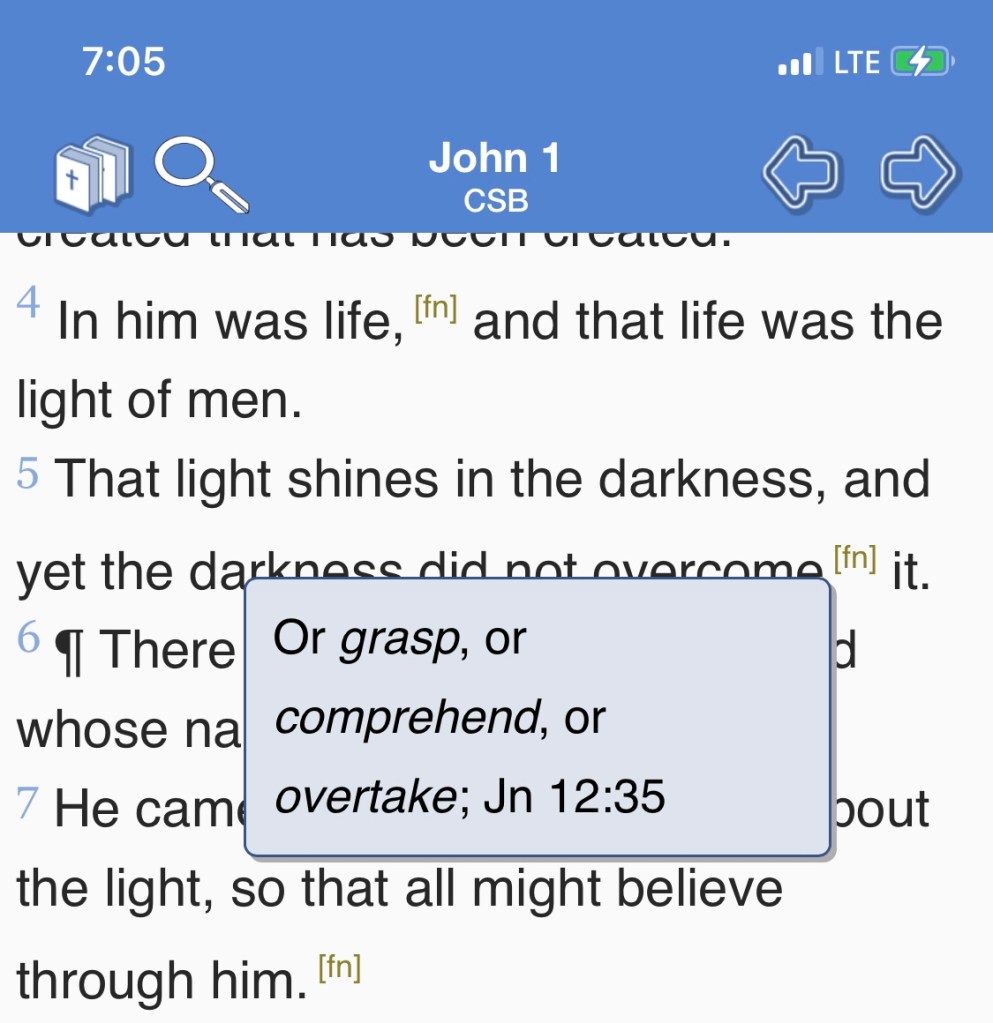
“And the light shineth in the darkness; and the darkness apprehended it not.”
John 1:5 (ASV)
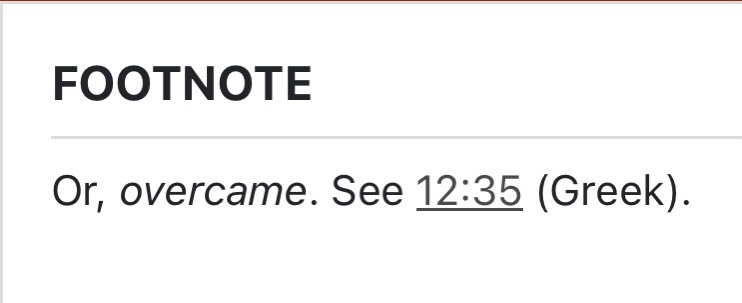
“Jesus therefore said unto them, Yet a little while is the light among you. Walk while ye have the light, that darkness overtake you not: and he that walketh in the darkness knoweth not whither he goeth.”
John 12:35 (ASV)
To comprehend something is to be able to overcome it… to understand your adversary is to then know how to outwit him! At least, that is one way I find myself thinking about the word “apprehend.” But John’s point is larger than my wordplay: the Light has come into the darkness.
YET—to state the obvious—I am not THE LIGHT. I need to hear Jesus’ warning here. Jesus was with them, ever there to guard them from straying from the path, from darkness overtaking them! Each of us is susceptible to temptation according to our weaknesses.
See James 1:12–18.
6. What Am I Really After?
What’s my LUST here? Significance? Meaning? Fame? To be looked up to. To supplant Christ? Do I want to be the saviour?
My pastor just preached a message out of Exodus 17, where Moses was upheld, literally, by Aaron and Hur. I’m not in charge. God’s given me a taste of being in charge at my co-op.
7. Impeccability, Mystery, and Revelation
Dr. Michael Barrett brings up a point: Satan may very well have thought that he could successfully tempt Christ! But we don’t get our theology from the devil.
Message on the Impeccability of Christ.
The poetry of God’s word to us, interpreting dreams, visions and prophecy… it’s not plain meaning—is it ever?
Jesus told his disciples why he spoke in parables, so that some would NOT understand. And yet there were and are those to whom God chooses to reveal it.
Jesus, full of the joy of the Holy Spirit:
“At that time Jesus, full of joy through the Holy Spirit, said, ‘I praise you, Father, Lord of heaven and earth, because you have hidden these things from the wise and learned, and revealed them to little children. Yes, Father, for this is what you were pleased to do.’”
Luke 10:21 (NIV)
8. Not Hearers Only
“Keep reminding God’s people of these things. Warn them before God against quarreling about words; it is of no value, and only ruins those who listen. Do your best to present yourself to God as one approved, a worker who does not need to be ashamed and who correctly handles the word of truth.”
2 Timothy 2:14–15 (NIV)
There’s two sides of the trend: one is to self-deprecate, the other is to mock others. But Galatians 6 says:
“Brothers and sisters, if someone is caught in a sin, you who live by the Spirit should restore that person gently. But watch yourselves, or you also may be tempted. Carry each other’s burdens, and in this way you will fulfill the law of Christ. If anyone thinks they are something when they are not, they deceive themselves. Each one should test their own actions. Then they can take pride in themselves alone, without comparing themselves to someone else, for each one should carry their own load.”
Galatians 6:1–5 (NIV)
I have myself been witness to an “expert in the law” who uses his knowledge of God’s word to excuse himself from the world. He lives in theory land, not sober, but rather constantly dissecting theology. He himself described the rabbit hole.
To know God is to do God’s word… to be doers of the word. James 1:22–26.
You can hear the word, study it, be an expert and still miss the point.
“But as for you, continue in what you have learned and have become convinced of, because you know those from whom you learned it, and how from infancy you have known the Holy Scriptures, which are able to make you wise for salvation through faith in Christ Jesus. All Scripture is God-breathed and is useful for teaching, rebuking, correcting and training in righteousness, so that the servant of God may be thoroughly equipped for every good work.”
2 Timothy 3:14–17 (NIV)
I want to warn the church that neither ignorance of God’s word nor education is the enemy. You can get lost in trying to come up with ways to overcome the questions and challenges lobbed against the truth of God’s word… refuting doubters?
Look at Luke 22:66–71. Was the council asking questions to enlighten themselves?
The questions that I, as a believer, have come to mind as I read his word do not shake my faith, because I know Christ. (Ephesians 1:13.) The Holy Spirit is my assurance, my confirmation.
But Matthew 7:1–6 always stands. This is a warning for me also, and the more so.
I often wonder, “Has my brother wandered into error?” If that’s the case my prayer is for his return to the simplicity of the gospel.
9. Discernment, Mental Health, and Spiritual Claims
On the other side of things I grew up in the PAOC. I’ve experienced charismatic churches of many kinds. I’ve also had a lifetime battle with (is it a battle?) where one places psychiatry and psychology in all of the clutter. When and how do we decide if my brother Andrew’s being haunted with being damned… is it a spiritual struggle or mental illness? And how do we avoid assuming that we can settle such a question from a distance? Spiritual care and appropriate mental-health care need not be enemies.
I’ve stayed away from independent charismatic churches because of the frequent error of leaders who run freely in the Spirit and suffer with the consequences.
They have a revelation that rings true, and may even agree with what God is speaking to our own hearts about. But then there is a branching off into error. How do we know when they go off what God is revealing and into what they themselves are being drawn toward? When I am in the presence of the man, I have more to go on than a distant claim: I can observe his character, his relationships, his life. Even then, my discernment is not infallible. God still uses imperfect people, and their influence still needs testing.
Katie, my cousin, was delivered from error, by God’s grace. “The Twelve Tribes” story is for another time.
The enemy wants to get us off track from the purpose of proclaiming the Good News!
10. The Work Given to Me: Be Ready
I continue to wrestle with my place in the church. I rest in his getting me to give up trying to know things in advance that he’s chosen to be the TBA kind.
In John’s gospel, Jesus is seen as having one destiny, the cross. He shunned those who wanted to take him by force to make him their king (see John 6). But in John chapter 2, John states a truth that is then demonstrated through the stories he relates in the coming chapters.
In the beginning of John chapter 4, what was Jesus’ reaction to his popularity? He left!
Be ready!
To be continued…

