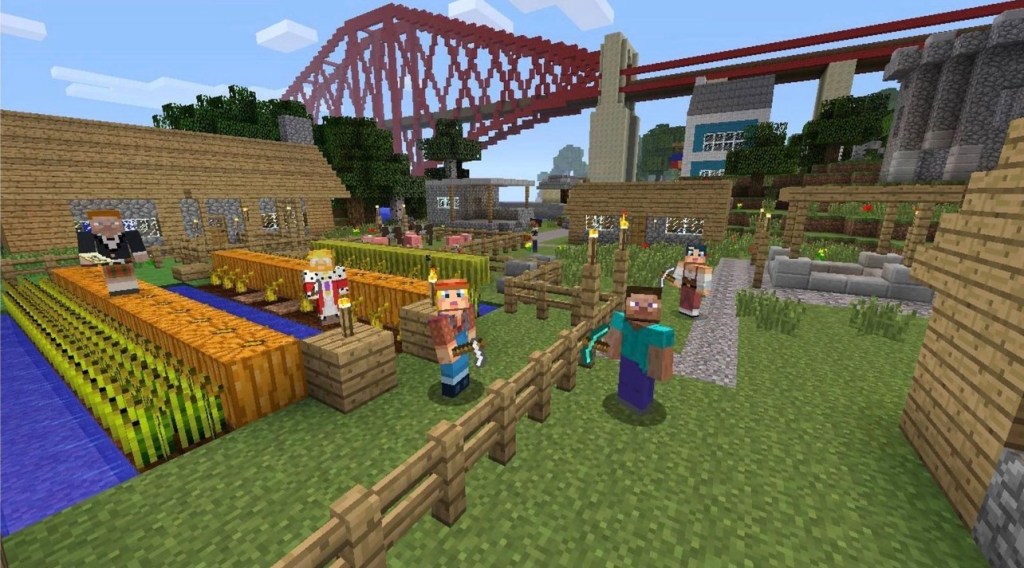
Minecraft Realms — A Place to Belong, Build, and Discover One Another
More Than a Minecraft Game
What if something as simple as a shared Minecraft world could become an opportunity for young people to discover friendship, cooperation, creativity, and belonging?
And what if it could also become a place where people of different generations discover gifts in one another that might otherwise go unnoticed?
That’s the larger idea.
Not necessarily another church program or ministry to organize, but an opportunity to explore what might happen when we bring people together around something they already enjoy.
Ashton — Discovering What’s Already There
Ashton has spent years playing Minecraft.
He understands how to create and manage worlds, establish permissions, introduce players, and maintain an environment where others can participate.
When he’s played with younger family members, he’s demonstrated an ability to manage the world while allowing others to explore and enjoy themselves.
These are skills he already possesses.
But what interests me most isn’t simply what Ashton might contribute to the Junior Youth.
It’s what they might contribute to him.
He could be good for them, and they could be good for him.
Rather than creating an activity specifically for Ashton, perhaps we could discover an opportunity for him to participate meaningfully in the lives of others.
Of course, whether Ashton would enjoy such a role is something we’d want to explore with him.
Romans 1:11–12 — Mutual Encouragement
Paul writes about his desire to visit the believers in Rome so that they might be strengthened.
But then he adds something remarkable.
He anticipates being encouraged by them, just as they would be encouraged by him.
It’s mutual.
Not simply one person ministering to another.
Both giving.
Both receiving.
I wonder whether this is something we could experience through a shared Minecraft Realm.
The young people might learn from Ashton.
Ashton might learn from them.
And perhaps relationships could develop that extend beyond Minecraft itself.
Intergenerational — Or Simply the Body of Christ?
Our church has ministries for men, women, youth, young adults, and other groups.
These are valuable.
But I’ve been wondering about the relationships that develop between those groups.
In 1 Corinthians 12, Paul describes the church as one body with many members.
Each member has something to contribute.
And the members who might appear less significant are no less necessary.
Perhaps intergenerational ministry doesn’t need to become another separate ministry.
Perhaps it can simply be something that happens when the different members of the body discover one another.
Not another satellite, but a coming together of the body.
A Minecraft Realm could become one small expression of that.
Josiah and Emily — Experience We Can Learn From
At Ashton’s birthday dinner, Josiah mentioned that he and Emily had participated in a family Minecraft Realm over Christmas.
That caught my attention.
They’ve already experienced something similar on a smaller scale.
They may have valuable insights into what worked, what didn’t, and what might be involved in creating a shared world for a larger group.
Rather than developing a proposal and asking others to implement it, I’d much rather explore the possibilities together.
Their experience, Ashton’s knowledge, and the Junior Youth leadership’s understanding of the young people could complement one another.
And there may be others who have something to contribute that we haven’t even considered.
Starting Small
Perhaps the first step could be a single Friday evening Junior Youth gathering.
An opportunity to introduce Minecraft Realms, invite interested young people to participate, and discover whether there’s enthusiasm for something more.
There would be practical questions to consider.
Different Minecraft editions and devices aren’t always compatible.
We would need to consider subscriptions, internet access, player permissions, and the number of participants.
And because we’re talking about young people, appropriate adult supervision, safeguarding, parental consent, and clear boundaries would be essential.
Ashton could potentially help with the technical aspects while the Junior Youth leadership remains responsible for supervising the activity.
But these are questions to explore together, not decisions already made.
Perhaps we’d discover that occasional Minecraft gatherings are enough.
Perhaps an ongoing Realm would be worthwhile.
Or perhaps the conversations would lead us somewhere entirely different.
The B-Team — Discovering Gifts
There’s another idea I’ve been exploring recently.
I’ve been calling it the B-Team.
Not because anyone is second-rate.
Quite the opposite.
It’s about recognizing that ministry isn’t limited to those who occupy visible positions or have successfully auditioned for a particular role.
Some people sing.
Some write.
Some teach.
Some encourage.
Some connect people.
Some know how to create extraordinary worlds in Minecraft!
1 Peter 4:10 reminds us that each person is to use the gifts they’ve received to serve others.
Perhaps our task isn’t always to create opportunities for people to become something.
Perhaps it’s sometimes simply to recognize what God is already doing in and through them.
And then make room for it.
What Would Success Look Like?
Not necessarily a thriving Minecraft server.
Not a new ministry department.
Not even a regularly scheduled activity.
Perhaps success would look like a young person discovering that Ashton is someone they enjoy spending time with.
Or Ashton discovering that he has something valuable to offer a group of younger people.
Perhaps friendships would develop.
Perhaps someone would discover an unexpected ability to teach, organize, create, or encourage.
Perhaps the participants would begin recognizing one another as fellow members of the body of Christ.
And perhaps we’d discover that Minecraft wasn’t really the important part after all.
The relationships were.
Where Do We Go From Here?
That’s something I’d rather not decide alone.
The next page is intentionally unfinished.
It’s a collaborative working document containing questions, possibilities, and practical considerations.
It’s an invitation for everyone interested to bring their own experience and ideas to the table.
Nothing is set in stone.
We may discover something worth pursuing.
We may discover something entirely different.
Or we may simply enjoy getting to know one another better.
And that would be worthwhile too.
➡️ Continue to Part 3 — Building This Together
A collaborative working document — an invitation to contribute ideas, questions, and experience.

