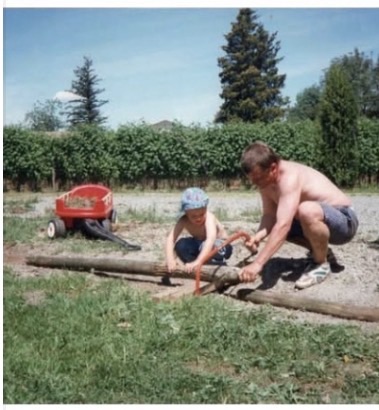
That boy, he’s mine, and I am his Daddy. I have always seen him. The picture here is immediately dynamic. It’s not merely allegory, but it is a picture of what’s going on in the realm that transcends the temporal realm.
It’s like I had raiders over power me, and carry off my life. They made my children their slaves.
And the God who allowed this to happen did so, to turn my heart to him. And once his possession, once I bore his name… he brought the captives one by one back to the promised land of being in my care.
It’s hard to talk about this without sounding full of myself.
But…
This message is to mothers and fathers. You are the primary fortification of your children’s sense of self. Many will try to define them, to speak into their lives, and to shape how they see themselves, but it is difficult (at best) for them to get past the name you place upon them.
I have come across two interesting scriptures in Deuteronomy that add some substance to what’s on my heart.
Then Moses and the Levitical priests addressed all Israel as follows: “O Israel, be quiet and listen! Today you have become the people of the Lord your God. So you must obey the Lord your God by keeping all these commands and decrees that I am giving you today.”
Deuteronomy 27:9-10
And the next is:
When the Most High gave the nations their inheritance,
when he divided all mankind,
he set up boundaries for the peoples
according to the number of the sons of Israel.
For the Lord’s portion is his people,
Jacob his allotted inheritance.Deuteronomy 32:8-9
Take a look at this post < HERE >
Judging Others
Do Not Judge Others
“Do not judge others, and you will not be judged. For you will be treated as you treat others. The standard you use in judging is the standard by which you will be judged.
“And why worry about a speck in your friend’s eye when you have a log in your own? How can you think of saying to your friend, ‘Let me help you get rid of that speck in your eye,’ when you can’t see past the log in your own eye? Hypocrite! First get rid of the log in your own eye; then you will see well enough to deal with the speck in your friend’s eye.
“Don’t waste what is holy on people who are unholy. Don’t throw your pearls to pigs! They will trample the pearls, then turn and attack you.
Matthew 7:1-6 NLT
The word judging is a bit ambiguous in English. There is a kind of judgement which is actually discernment.”
To judge in the sense Jesus is speaking of as recorded there in Matthew 7 is what I’ve pondered for quite some time now.
Who Am I?
I have no credentials to put behind my name. I have a calling to call out to the ones God is already speaking to. Those that listen to me do so because they hear me speaking in their language, like the diaspora in Acts 2.
If you can hear what I am saying, then it is God who is giving us to one another.
Scoffers will judge me, file me in a drawer with the label: _________
Every once in a while, when I meet a new group of people, or a new person that gets to know me well enough, I hear them say, “I’ve never met anyone like you.“ And I really don’t think it’s my anxiety, because I’m pretty calm about it. I don’t fit into an easy category of person.
There’s a mirror that used to hang in the front hallway of the home where I grew up in Winnipeg. I don’t know how old I was, but I was very young. I took it down, and I wrote on the back, “always be yourself, never be anyone else’s copy”
For the longest time I thought that was a natural thing for anyone to do that had three older brothers and a younger sister. Searching for my identity in such a strong family, and by strong, I mean, strong personalities, but I realize now that it was God he was telling me way back then that this was my calling, that I was not to fashion myself after those around me. But even as I say this, I realize it was God who’s telling me that he will be forging me to make me from those all around me. This is not a point of pride. It feels like a curse sometimes! But being submitted to him, it’s a beautiful thing, it’s the name that he gave me!
Every time I write, or and moved to speak, my objection has been pretty much identical to that of Moses, “…but who am I, that they should listen to me?”
So again I say, if you can hear me, it’s because I’m speaking your language.
Take a look,
Then how is it that each of us hears them in our native language?
Acts 2:8
- Is always thought that those who heard Peter were all from the same country, but take a look!
9 Parthians, Medes and Elamites; residents of Mesopotamia, Judea and Cappadocia, Pontus and Asia, 10 Phrygia and Pamphylia, Egypt and the parts of Libya near Cyrene; visitors from Rome 11 (both Jews and converts to Judaism); Cretans and Arabs—we hear them declaring the wonders of God in our own tongues.
But nevertheless, I am who I am. I know a little bit about the biblical languages, I took one year of biblical Greek during my one year of college. way-back-when.
κρίνω
One way to frame it is what happens when giving a person a name. A label. Branding them forever.
As i write, my attention keeps returning to my own plank, my own history, my own tendencies.
I particular I’ve been thinking in terms of conversations about parenting. This can so often go wrong when they become prosecutions instead of invitations.
Something else I’m noticing is I’m concerned not so much about judgement in order to identify bad behavior. Scripture does that all the time. The concern is when behavior can become identity.
There is a profound difference between:
“You lied.” “You are a liar.”
Between:
“That was a foolish choice.” “You are foolish.”
Between:
“You acted rebelliously.” “You are a rebel.”
The first names an action.
The second names a person.
The Bible consistently separates the person from the act while still taking the act seriously.
God’s Pattern: Calling People by Their Future
Think of how God speaks.
Abram becomes Abraham. Jacob becomes Israel. Simon becomes Peter.
God certainly exposes sin, but He is remarkably reluctant to define people permanently by their failures.
Even when Gideon is hiding in fear, the angel greets him as:
“The LORD is with you, mighty warrior.”
Judges 6:12
God saw something that Gideon himself could not yet see.
As a father I have tremendous power because my words help shape how a child sees himself. As one who works in a school, even as a bus driver, I’ve had to realize this Power of Naming.
Proverbs is full of warnings about the tongue.
Proverbs says:
“Death and life are in the power of the tongue.” (Proverbs 18:21)
That verse is often abused, but at minimum it teaches that words are not neutral.
A father’s repeated words can become part of a child’s inner voice. Even teachers and adults that are in a position of authority over a child can be to a degree, effectively altering the child’s self perspective.
Years later the child may no longer hear his father speaking, but still hear:
“You’re lazy.” “You’re stupid.” “You’ll never learn.” “You’re just rebellious.”
The father may have intended correction.
The child may receive identity.
Ephesians Gives The Balance
The verse that keeps coming to mind from your description of Nicholas is:
“Speaking the truth in love…” (Ephesians 4:15)
Notice Paul does not say:
Speak love without truth. Speak truth without love.
Truth without love becomes a hammer.
Love without truth becomes neglect.
The Christian task is both.
I already see this in myself:
My gentleness can become failure to confront evil.
That is an important insight.
The shadow side of gentleness is avoidance.
The shadow side of truth-telling is harshness.
Both distortions miss Christ.
Jesus was:
“full of grace and truth.” (John 1:14)
Not grace instead of truth. Not truth instead of grace.
Both.
Fathers In Particular
One text that comes to mind is:
“Fathers, do not provoke your children to anger, but bring them up in the discipline and instruction of the Lord.” (Ephesians 6:4)
And its companion:
“Fathers, do not embitter your children, or they will become discouraged.” (Colossians 3:21)
Colossians uses a fascinating word.
The concern isn’t merely that the child becomes angry. The concern is that the child loses heart.
Discouragement.
A child who concludes:
“Why try? I’m already the problem.”
That is exactly the kind of wound I am concerned about.
Ananias and Sapphira
What About Ananias and Sapphira? It’s a story found in the beginning of the book of Acts.
Take a look.
Peter did not create their judgment.
Peter exposed what was already true.
The Holy Spirit judged.
Peter’s role was revelation, not condemnation.
In your relationship with your children, with any child under your care, are you trying to point toward Scripture and allow the Holy Spirit to do His own work?
That is a much safer place to stand.
Be Careful Little Tongue
A Passage I recommend spending time in is James 3. James may be one of the strongest passages in Scripture regarding speech.
James says:
“The tongue is a small part of the body, but it makes great boasts.”
And:
“With the tongue we praise our Lord and Father, and with it we curse human beings, who have been made in God’s likeness.”
Notice the reasoning.
Why is cursing people so serious?
Because they bear God’s image.
A child bears God’s image.
A father speaks to an image-bearer.
That reality should make every parent cautious. Every teacher and pastor of children cautious.
Prayer
Each of us is at some point an influencer of children. And also we are witness and influence of someone who themselves are a parent.
Always ask this:
Am I trying to help [a parent] see their children differently,
or
Am I trying to get them to admit I am right, I am the one to follow into good parenting.
Those are very different missions.
The first leaves room for the Spirit.
The second usually becomes an argument.
If you approach parent from that same posture—not “I have diagnosed your problem” but “I have seen this wound travel through generations, including through me”—the conversation may land very differently.
One more passage worth meditating on:
“A bruised reed he will not break, and a smoldering wick he will not snuff out.” (Matthew 12:20)
Christ confronted sin relentlessly.
Yet people left His presence feeling called upward rather than permanently labeled downward.
That may be the clearest model for the conversation any of us can have as we walk this world’s road along side of young parents and care givers.
My friend:
Not sure if this will help.
John 16:16-33
New Living Translation
Sadness Will Be Turned to Joy
16 “In a little while you won’t see me anymore. But a little while after that, you will see me again.”
17 Some of the disciples asked each other, “What does he mean when he says, ‘In a little while you won’t see me, but then you will see me,’ and ‘I am going to the Father’? 18 And what does he mean by ‘a little while’? We don’t understand.”
19 Jesus realized they wanted to ask him about it, so he said, “Are you asking yourselves what I meant? I said in a little while you won’t see me, but a little while after that you will see me again. 20 I tell you the truth, you will weep and mourn over what is going to happen to me, but the world will rejoice. You will grieve, but your grief will suddenly turn to wonderful joy. 21 It will be like a woman suffering the pains of labor. When her child is born, her anguish gives way to joy because she has brought a new baby into the world. 22 So you have sorrow now, but I will see you again; then you will rejoice, and no one can rob you of that joy. 23 At that time you won’t need to ask me for anything. I tell you the truth, you will ask the Father directly, and he will grant your request because you use my name. 24 You haven’t done this before. Ask, using my name, and you will receive, and you will have abundant joy.
25 “I have spoken of these matters in figures of speech, but soon I will stop speaking figuratively and will tell you plainly all about the Father. 26 Then you will ask in my name. I’m not saying I will ask the Father on your behalf, 27 for the Father himself loves you dearly because you love me and believe that I came from God.[a] 28 Yes, I came from the Father into the world, and now I will leave the world and return to the Father.”
29 Then his disciples said, “At last you are speaking plainly and not figuratively. 30 Now we understand that you know everything, and there’s no need to question you. From this we believe that you came from God.”
31 Jesus asked, “Do you finally believe? 32 But the time is coming—indeed it’s here now—when you will be scattered, each one going his own way, leaving me alone. Yet I am not alone because the Father is with me. 33 I have told you all this so that you may have peace in me. Here on earth you will have many trials and sorrows. But take heart, because I have overcome the world.”

